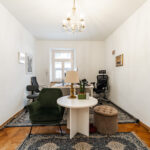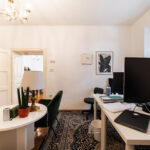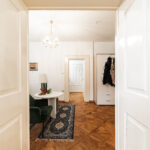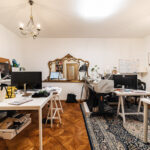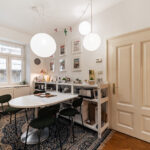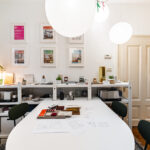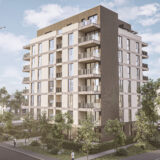
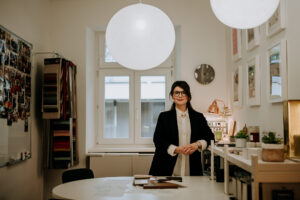
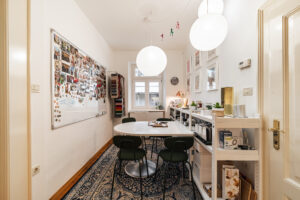
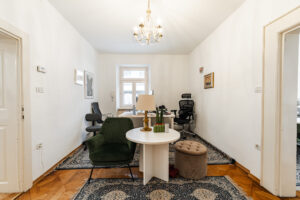
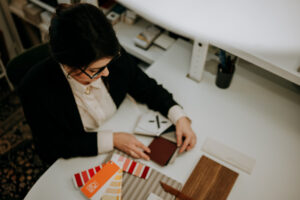
Architect Nina Štajner, who works in tandem with Mateja Katja Vrtovec Jerančič under the name NIŠA arhitektura, welcomed us into her business premises in the center of Ljubljana. Their business premises reflect their unique style through various elements, combining modern minimalism with an eclectic vintage touch.
She also expresses her creativity as the host of the Delo in Dom podcast, where she discusses a wide range of topics related to quality of life with a variety of guests. In our conversation, she reveals how her career took a turn towards interior design after she finished her architecture studies and what the future holds for her in the field of interior design and construction.
How did your journey in architecture begin and how did you end up in interior design?
I have been very creative since I was little, as I was interested in everything related to aesthetics, from fashion, art, art history, and, of course, architecture. My mother was a civil engineer specializing in low-rise buildings, and she was also very involved in exterior design. When I enrolled in college, my family told me, “There will always be construction, so a career in this field is a good choice.” How ironic. I finished my studies right at the height of the financial crisis, when construction slowed down, but it was this turning point that led me into the world of interior design. At that time, there weren’t many opportunities to work in architectural firms, so due to a combination of circumstances, I started working with an architect who published a lifestyle magazine. This led me into the world of lifestyle journalism and online content creation (before it was even called that). In addition, I became more familiar with interior design, which was not yet a widespread industry at the time. During the crisis, there were many more renovations than new constructions, so people had a greater need for such services.
What inspires you and where do you find inspiration for your projects?
I try to avoid looking for inspiration online, as I am not sure that this is appropriate in the age of artificial intelligence. Many of the reference examples online are not realistic at all, and when designing a space, it is necessary to keep in mind the space we are working with at that moment. I prefer to draw inspiration from the real world, visiting different kinds of spaces and experiencing things firsthand. I also feel a close connection to Plečnik and his thinking, especially his philosophy of using simple materials to create unique solutions that are not financially burdensome.
What are the most common mistakes you see in renovations?
I notice two mistakes in particular. The first is seeking inspiration in projects that are not relevant to the actual situation, and the second is rushing, because we want everything right away. The fact is that everything takes time, especially space. To avoid mistakes, it is necessary to plan the space, think carefully, and consider all the details, as it is cheaper and easier to make corrections on paper than during implementation.
Do architects build for actual users?
Although I am an architect by profession, it is interesting to comment on this, but since I now mostly focus on interiors, I notice an increasing discrepancy between these two areas. In our office, we are receiving more and more new construction projects that require a complete change of floor plan. This is particularly evident in new multi-apartment buildings, where the space is not laid out in the most functional way, and where one can also notice non-functional details such as doors opening in the wrong direction, etc. We also receive individual projects where the investor commissions the architecture from an architect and the interior design from us. In such cases, we notice that architects may pay more attention to the exterior appearance of the building, while we are given the opportunity to improve the floor plan layout of the interior, personalize the interior to the user, and take care of the details of the ambience.
How do you balance the client’s wishes with your professional knowledge?
This conflict is always present, but in the end, I always draw the line that I will not be living in this space, so the client’s wishes are more important. The fact is that we architects have more mileage and experience behind us than clients who have only experienced the process of renovating or furnishing a home once. During the planning process, we also notice potential problems that investors find more difficult to predict themselves. My colleague Mateja and I at NIŠA arhitektura therefore plan with integrity, especially when it comes to the functionality of the space, while aesthetically we like to find challenges in adapting to the wishes of investors.
Why do individual projects take longer than clients expect?
Mainly because each project requires its own time. We often receive unrealistic requests such as: “We would like to move in in a month, the contractors are already on site, can you draw up a plan for us?” In these cases, disappointment ensues, as we have ongoing projects on the table and usually order new ones several months in advance, and the development of the project itself takes time. It is a creative process, and sometimes an idea does not come immediately and takes some time to develop, to go from the mind to paper. Even after the idea is born, we need time to draw it out in detail. Unfortunately, artificial intelligence does not help us enough here, as it is not yet sufficiently developed. Space planning is not an instant activity; it requires careful consideration, as it involves permanent interventions that can significantly affect the quality of life.
Are there any trends that you consciously avoid?
There are many, but personally I strive for timeless aesthetics. I would say that we have had our fill of minimalist spaces without personality. The basis can be visually neutral, but we can add personality with elements that are easier to change, such as wall color and decorative elements. I encourage my clients to think about what makes their heart sing and where!
How do you see the future of living spaces?
I see this world of trends as very dualistic. On the one hand, I see a continuation of the trend of typical new buildings and hyper-production of villa blocks, but at the same time, there is a significant return to a more thoughtful individual approach and construction with natural materials such as wood and clay.
The future of interior design, at least for the next couple of seasons, points to a return to strong colors, a mix of historical styles, bold patterns, textures, and rounded shapes, which I warmly welcome.
How can a well-designed business space influence a company’s success?
The business space gives customers their first impression of the company when they enter, so it is advisable for entrepreneurs to also consider the feelings that customers experience when they first step through the door.
A functionally designed space is also important for the well-being of employees and, ultimately, for the success of the company. As an example, I can cite the trend of open-plan offices, where all departments are connected. This type of floor plan is really suitable for some jobs where employees are immersed in their virtual world. However, for business premises where activities requiring, for example, telephone communication take place, such an environment can be disruptive. To sum up, every space must be adapted to its users and their needs.
What is your architectural advice for our readers?
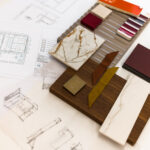
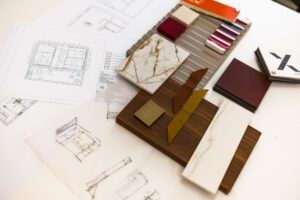
Draw more often and build less often. It is easy to draw a floor plan to scale using graph paper. Even in real space, we can help ourselves with masking tape when planning, using it to mark the desired locations of furniture, switches, sockets, and other elements. I would also like to emphasize: do not rely too much on artificial intelligence (yet); it can be an excellent support in testing ideas, but you cannot rely on it (yet).